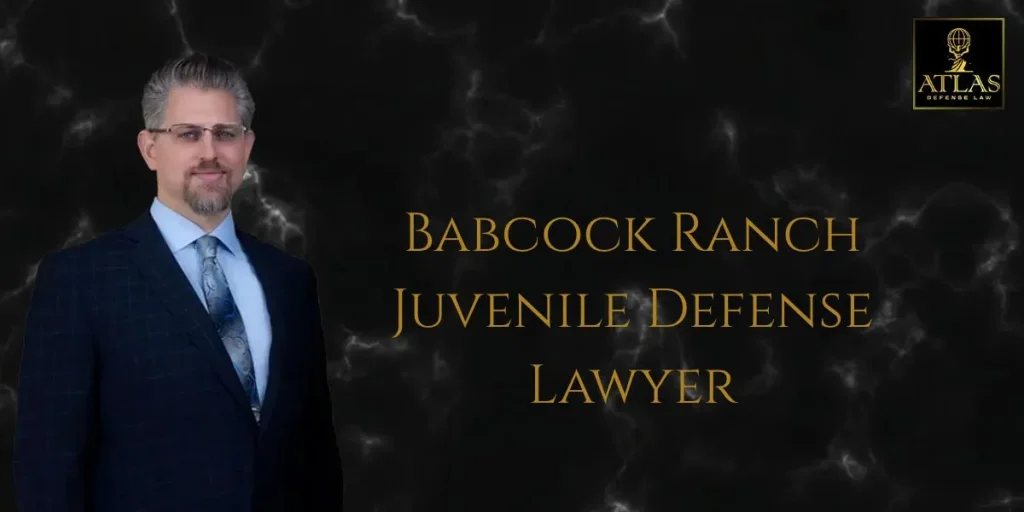
A child’s arrest turns a normal week upside down. Parents want straight answers about what their child is facing and who can guide them through it. A Babcock Ranch juvenile defense lawyer at ATLAS Defense Law can explain the process in plain language and start reviewing your child’s case right away.
Attorney Benjamin Abdulnour is an experienced criminal defense lawyer in Babcock Ranch. He has practiced criminal law since 2009 and won S.G. v. Vurro, a published Florida appellate ruling that found a child’s secure detention illegal.
He answers his own calls, so the person who first hears about your child’s arrest is the same person who argues the case in court.
Florida does not call it a crime when a minor breaks the law. It is called a delinquent act, and the case moves through the juvenile system.
The State Attorney has several options, including:
For certain older teens facing serious felony charges, Florida law lets a prosecutor send the case straight into adult criminal court instead of juvenile court. This is called a direct file under Florida Statutes Section 985.557.
Once a case moves that way and the youth is found to have committed the offense, the youth is treated as an adult for any future law violations unless the criminal court imposes juvenile sanctions as provided by law. The decision to direct file can shape far more than one court date.
We handle a wide range of juvenile cases for families across Babcock Ranch, Charlotte County, and Lee County, including:
Whatever the charge, our juvenile defense attorney’s goal stays the same: we work to keep your child out of a locked facility when possible and protect a clean record going forward.
Benjamin Abdulnour has built a record that includes more than 50 trials to verdict. His most notable juvenile victory, S.G. v. Vurro, reached Florida’s Second District Court of Appeal, which ruled that holding a child in secure detention for violating a truancy order was illegal.
Before law school, he earned a dual degree in philosophy and political science from the University of Florida, training that shows up in how he builds an argument for a judge. He also serves as President of the Lee County Legal Aid Society, work that keeps him connected to the courts and agencies across the circuit.
Prior results do not guarantee a similar outcome, but that history shapes how he approaches every new juvenile case.
The work starts the moment you call. We review the arrest report, the risk assessment used to decide on detention, and any witness or video evidence before your child’s first hearing.
If your child qualifies, we push for a civil citation or a similar diversion program instead of a formal petition, since a completed program is not treated as an adjudication of delinquency (a formal court finding).
When a case does move forward, we focus first on the detention hearing, because keeping a child out of secure detention while the case is pending often shapes everything that follows. From there, we negotiate with the State Attorney’s Office, file the motions the facts support, and prepare for trial if the state will not offer fair terms.
Yes. If your child is detained and the state files a delinquency petition, an arraignment hearing must be held within 48 hours after the petition is filed, excluding weekends and legal holidays. Decisions made before that date affect detention, diversion eligibility, and the charges themselves.
The first hearing usually covers two questions. One is detention: whether your child stays home or goes to a jail-like facility that holds youth assessed as a risk to public safety while they await court proceedings. The other is whether the state will file a formal petition.
Babcock Ranch sits across both Charlotte and Lee counties, and both fall under Florida’s Twentieth Judicial Circuit. Depending on where the arrest happened, your child’s case is typically filed at the Lee County Justice Center at 1700 Monroe Street in Fort Myers or the Charlotte County Justice Center at 350 East Marion Avenue in Punta Gorda. The same circuit rules apply either way.
Not usually. Under Florida Statutes Section 943.0515, the Florida Department of Law Enforcement (FDLE) will automatically expunge a person’s juvenile criminal history record once they turn 21, and if the person was classified as a serious or habitual juvenile offender, that timeline extends to age 26. Some cases also qualify for sealing earlier.
Sometimes. First-time, lower-level offenses may qualify for a civil citation or a similar prearrest diversion program instead of a court petition. Completing the program is not an adjudication of delinquency and keeps the case out of a formal record.
When a youth is arrested in Lee County, the arresting officer brings the youth to the Juvenile Assessment Center of Lee County. Arrested youth in Charlotte, Hendry, and Glades counties who are eligible for secure detention are also booked there before being transported to the Southwest Florida Regional Juvenile Detention Center.
Yes. ATLAS Defense Law offers a free consultation so you can understand the charges, the likely timeline, and the options still open to your family before deciding how to move forward.
Every week that passes brings your child closer to the next deadline, whether that is an arraignment date or a diversion program that closes once a formal petition is filed.
Benjamin Abdulnour answers his own calls, so you speak directly with the person who will handle your child’s case from the start. Contact us today to get clear answers about what happens next.

Arrested? FIGHT BACK. CALL US NOW!
Call For A Consultation
239-208-1500
"*" indicates required fields
Fort Myers Office
2256 First Street, Suite #180
Fort Myers FL 33901

Copyright © 2026. Atlas Defense Law. All Rights Reserved. Disclaimer | Site Map | Privacy Policy. Digital Marketing By: 
*Images are obtained under license from Canva and other third-party stock image providers, with attribution included where required.
